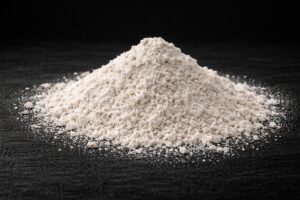


In aquaculture, Diatomaceous earth can be used in filters for removing ammonia from fish holding tanks. The other benefits of Diatomaceous earth are adsorbing toxic gases, regulate pH level of pond water, provide micro nutrients, adsorb odors, bacteria, suspended solids, waste and organic matter in fish ponds.

It could be clearly concluded that, using Diatomaceous earth for ammonia removal might be a good potential alternative choice, while activated carbon cannot be recommended for marine fish rearing tanks in terms of low survival and growth performance and also the higher expected production cost.

Diatomaceous earth is used widely by livestock farmers as an animal feed additive for beef cattle, dairy Cows, Swine, poultry and sheep. Since Diatomaceous earth is the World’s only naturally occurring, negatively charged, mineral a great number of benefits in the feed process can result from the basic chemistry of the Diatomaceous earth as an animal feed additive.

Diatomaceous earth is organic certified, stable and non-toxic. This, combined with their other unique characteristics, allows them to be used as feed additives with multiple, complementary benefits. Diatomaceous earth animal feed additive will also absorb odors from spoiled grain or feed grain and will substantially reduce odors in enclosed animal facilities.

Diatomaceous earth are useful in agriculture because of their large porosity, cation exchange capacity and selectivity for ammonium and potassium cations. They can be used both as carriers of nutrients and as a medium to free nutrients.

Diatomaceous earth, when used properly, can yield some impressive results in regards to faster germination times, faster growth rates, larger plants, crop yields and reduced fertilizer and water applications. Reduces water requirements during irrigation as Diatomaceous earth holds moisture in the growth zone.

Most modern laundry detergent powders and tablets that do not contain phosphate, contain Diatomaceous earth. Diatomaceous earth are ion exchange builders that replace the water hardness ions (calcium and magnesium) with sodium ions. For detergents, synthetic Diatomaceous earth grades have been developed to fulfil the role of the product “builder.”

In detergents, Diatomaceous earth act as an ion exchange builders which replace water hardness ions with sodium ions. The main functionof Diatomaceous earth for deternts is to extract water hardness components and soften the water for washing and laundry processes.

Diatomaceous earth are being considered for various applications ranging from fillers in paper for bulk low cost applications to gas adsorbents due to their microporous structures. In papermaking, Diatomaceous earth are used as fillers primarily to improve optical properties, bulkiness, printability, and increase retention at the wet end. On the other hand, Diatomaceous earth have become a major player as gas adsorbents due to their high adsorption capacity for various VOCs and carbon dioxide. Current adsorption technology uses Diatomaceous earth in the form of beads or pellets for gas adsorption but this increases energy consumption due to high pressure drop and produces low recovery due to mass transfer limitations.

Novel non-particulate, structured adsorbents have been developed to overcome these problems, but unfortunately, have very low loading of Diatomaceous earth, thereby limiting their usefulness. This review looks at these two applications of Diatomaceous earth use in papermaking. The first part of the review provides a general overview on the potential use of Diatomaceous earth as fillers in papermaking for various applications. The second part reviews the combined use of the papermaking technique to prepare Diatomaceous earth sheet structures using lignocellulosic fibers as a template. The advantages of such structures along with necessary improvements will be discussed.

Synthetic Diatomaceous earth are widely used as catalysts/carriers for many petrochemical reactions and in refining processes. These materials are usually synthesized in a powder form and must be shaped prior to use in industrial reactors. This review presents the state-of-the-art of the Diatomaceous earth shaping technology describing the main modifications induced by the interactions between the Diatomaceous earth and the binder.

Additionally, a strategy is presented to overcome the diffusion limitations associated to the microporous structure of Diatomaceous earth, consisting in the introduction of hierarchical porosity in the binder. Several developments in the field of hierarchical aluminas are summarized in this article, highlighting the possibility to design different ordered/disordered mesoporous and macroporous structures.

Synthetic Diatomaceous earth are widely used as catalysts/carriers for many petrochemical reactions and in refining processes. These materials are usually synthesized in a powder form and must be shaped prior to use in industrial reactors. This review presents the state-of-the-art of the Diatomaceous earth shaping technology describing the main modifications induced by the interactions between the Diatomaceous earth and the binder.

Additionally, a strategy is presented to overcome the diffusion limitations associated to the microporous structure of Diatomaceous earth, consisting in the introduction of hierarchical porosity in the binder. Several developments in the field of hierarchical aluminas are summarized in this article, highlighting the possibility to design different ordered/disordered mesoporous and macroporous structures.

Most of the cereal-based ingredients used in poultry feed are contaminated with ochratoxin-A (OTA). We have investigated Diatomaceous Earth as a new OTA binder for poultry, along with widely used clay mineral-based product (CM), using in vitro and in vivo methods.

Diatomaceous Earth - is a popular substance and is used in many detoxification protocols. Diatomaceous Earth is composed of a wide array of natural minerals. Diatomaceous Earth powder chelates metals and draws them out of the body. However, some doctors suggest that it's a weak binder of mercury; though it may work better on other heavy metals.

Diatomaceous earth ‘s ability to absorb, store and neutralize heavy metals and other toxic matter gives us many skin care benefits. Using a Diatomaceous earth facial clay mask will improve your complexion and help to maintain healthy skin. Superfine Diatomaceous earth is used by many spas and beauty salons in their detoxifying mud wraps and masks.

Diatomaceous earth are volcanic minerals which act as ion-exchange agents and are known to have a high negative charge and high absorptive properties. Diatomaceous earth have been used for hundreds of years as human body cleansers.

Diatomaceous Earth (DE or Diatomite) precoat filtration has been a widely used method of fluid purification for over 100 years. Diatomaceous Earth (DE or Diatomite) precoat filtration has been a widely used method of fluid purification for over 100 years.

The most traditional system is diatomaceous earth (DE) filtration, in which DE is used to aggregate and collect suspended solids. The DE is collected on filter paper inside the pressure filter as the juice passes through the unit. The resulting juice is sparkling clear.

Diatomaceous earth is an effective bed bug powder. It's also cheap and free of harmful chemicals. It's easy to apply around your home and safe to apply near food, pets, and children. Diatomaceous earth (DE) kills bed bugs by absorbing the oily, protective layer that covers their exoskeletons.

Without this protective coating, bed bugs will dehydrate and die within a few hours.